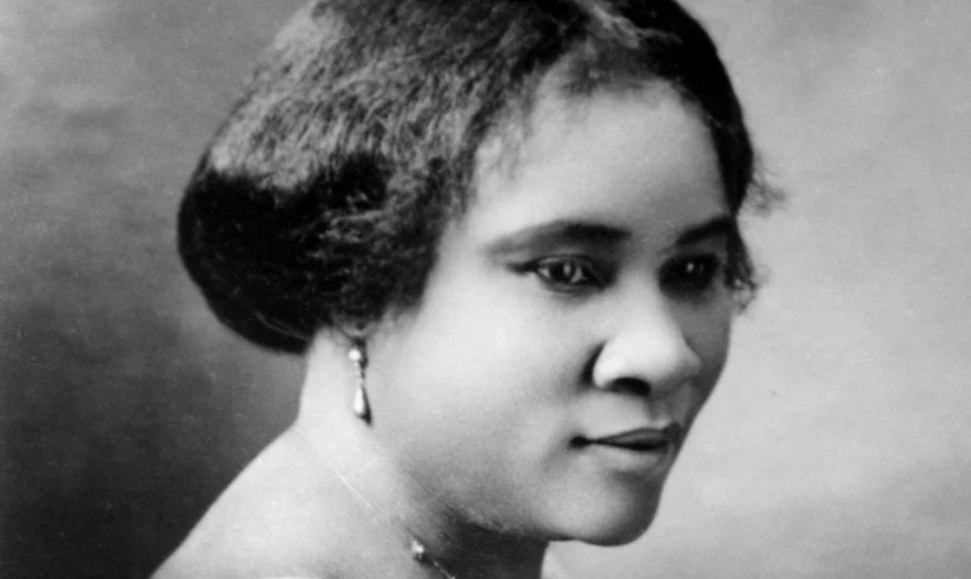

The Legacy of Madam C. J. Walker
When you think about beauty pioneers in American history, names like Estée Lauder and Elizabeth Arden might come to mind. Long before them was a woman whose influence was far greater in both social impact and sheer ingenuity. Madam C. J. Walker. She didn’t just create hair products — she created an economic movement that empowered tens of thousands of Black women. She also changed how beauty and business intersected in the early twentieth century.
Her rise from the cotton fields of the post–Civil War South to becoming the first documented self-made female millionaire in the United States is one of the most extraordinary American success stories — filled with innovation, grit, controversy, and legacy.
This post may contain affiliate links and professional skincare commentary. For full details, please read my disclaimer.
Born in Slavery
Madam C. J. Walker entered the world as Sarah Breedlove on December 23, 1867, on a cotton plantation near Delta, Louisiana. Her parents, Owen and Minerva Anderson Breedlove, had been enslaved prior to the Civil War and were freed shortly before her birth. Growing up in the Redemption Era — the turbulent period after the Civil War when Black Americans were promised freedom but faced harsh racial violence and economic exploitation — Sarah’s childhood was marked by hardship from the start.
Her parents died when she was just seven years old, leaving her and her siblings to fend for themselves. With little formal education and hard labor on sharecropped cotton fields as her only experience, Sarah’s early life was defined by physical survival rather than dreams of business success. She eventually moved to Vicksburg, Mississippi, to live with her older sister and abusive brother-in-law. It was this brutal environment — back-breaking work, economic insecurity, and constant toil — that forged a resilience she would later draw upon to build an empire.
Marriage for Freedom
At 14 years old, she married Moses McWilliams to escape her brother-in-law’s cruelty, and at 16, she gave birth to her daughter, A’Lelia (Lelia) Walker. Two years later, Moses died, leaving Sarah a young widow and sole provider. She moved to St. Louis, Missouri, where her brothers worked as barbers, and took work as a laundress — often earning as little as $1.50 per day. Even with such meager wages, she made a point to send A’Lelia to public school and attended night school when she could.
It was in St. Louis that Sarah experienced a scalp condition that caused significant hair loss, a condition common in working-class homes without indoor plumbing, gentle cleansers, or resources for proper grooming. While many women had the same problem, there were no products specifically designed for Black hair textures or scalp issues at the time. This experience would become a catalyst, inspiring the beauty revolution she would later lead.
The Birth of a Vision
Around 1904, she joined the sales force of Annie Turnbo Malone, a successful Black hair care entrepreneur who had developed the Poro line of products. As a commissioned agent, she learned how to sell hair products door-to-door, build trust with clients, and adapt marketing strategies on the fly. Malone’s success gave her a model to follow — but also set the stage for future rivalry.
In 1905, Sarah moved with A’Lelia to Denver, Colorado, where she continued selling Poro products but also started working as a cook for pharmacist Edmund L. Scholtz. Scholtz likely helped her understand the chemistry behind cosmetic formulas, knowledge she eagerly absorbed. Sarah began developing her own hair care solutions, experimenting with ingredients and methods.
In 1906, she married Charles Joseph Walker, a newspaper man who helped her refine marketing copy and promotional materials. It was her third marriage, and she took his name professionally as “Madam C. J. Walker” — a title inspired by European beauty culture that made her sound cultured and authoritative. Shortly after, she launched her first major product: Madam Walker’s Wonderful Hair Grower.
Creating a Hair Care System
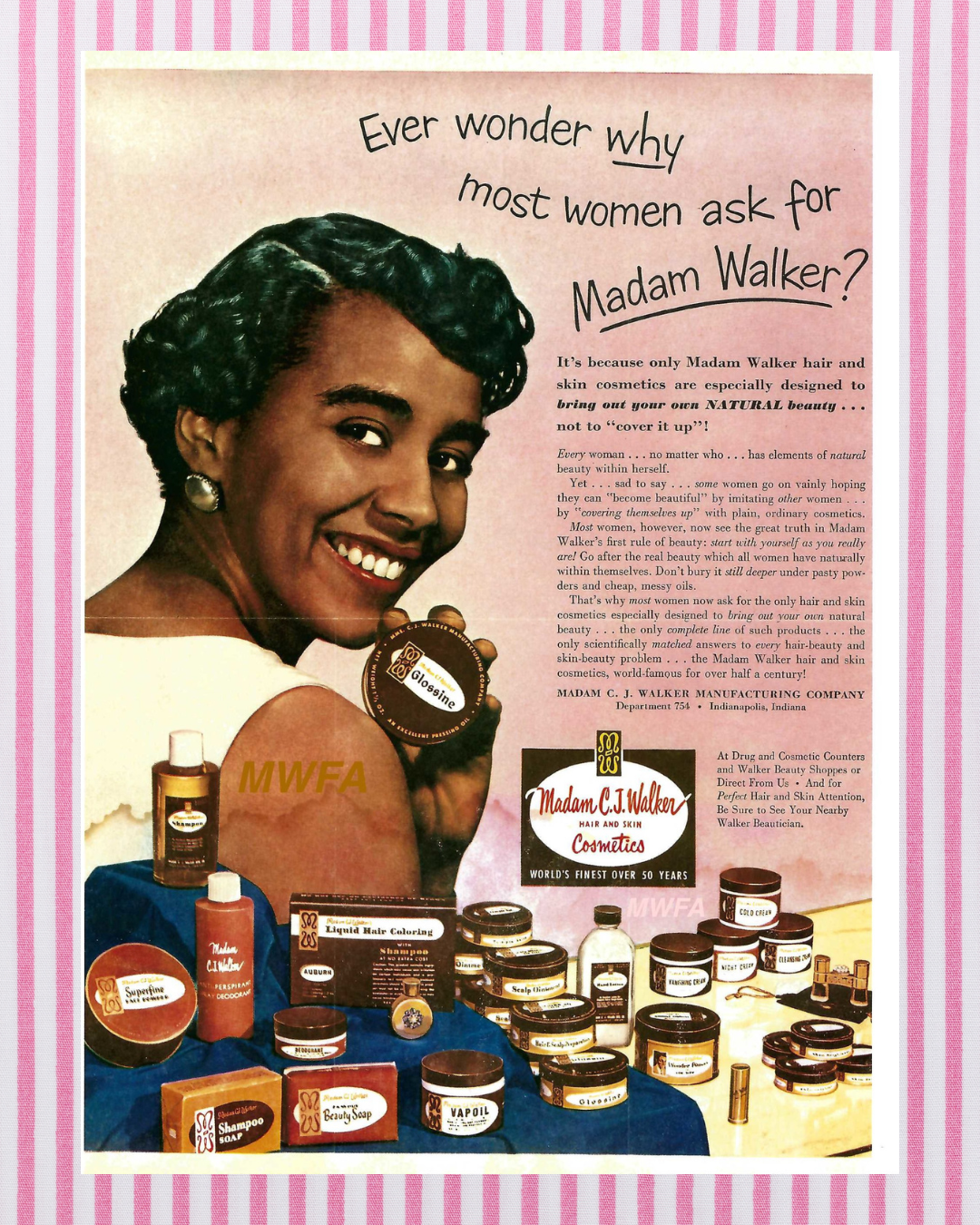
Unlike many beauty entrepreneurs who only sold formulas, Madam C. J. Walker developed a complete hair-care system. She didn’t simply bottle an ointment and hope people liked it — she created a Walker Method that combined specialized products with training, demonstration, and education.
Her original product line included:
•Madam Walker’s Wonderful Hair Grower: a scalp conditioning formula designed to treat dandruff and hair loss
•Vegetable Shampoo: for more gentle cleansing
•Glossine: a pressing oil to give hair shine
•Temple Salve and Tetter Salve: for scalp comfort and healing
These products worked together as a regimen, and Walker encouraged women to adopt the full system for best results. This approach was far ahead of its time — it created brand loyalty, identity, and a consistent customer experience that mimicked professional salon service.
Walker sold her products directly to Black women, first in Denver and then across the South and Southeast, traveling with trunks of products and demonstrating her system in churches, lodges, and community events. These demonstrations were part sales pitch, part education, and part performance, showcasing results rather than just telling women they worked. Her skill in connecting with customers face-to-face was a key early marketing strategy.
Building a Business Empire
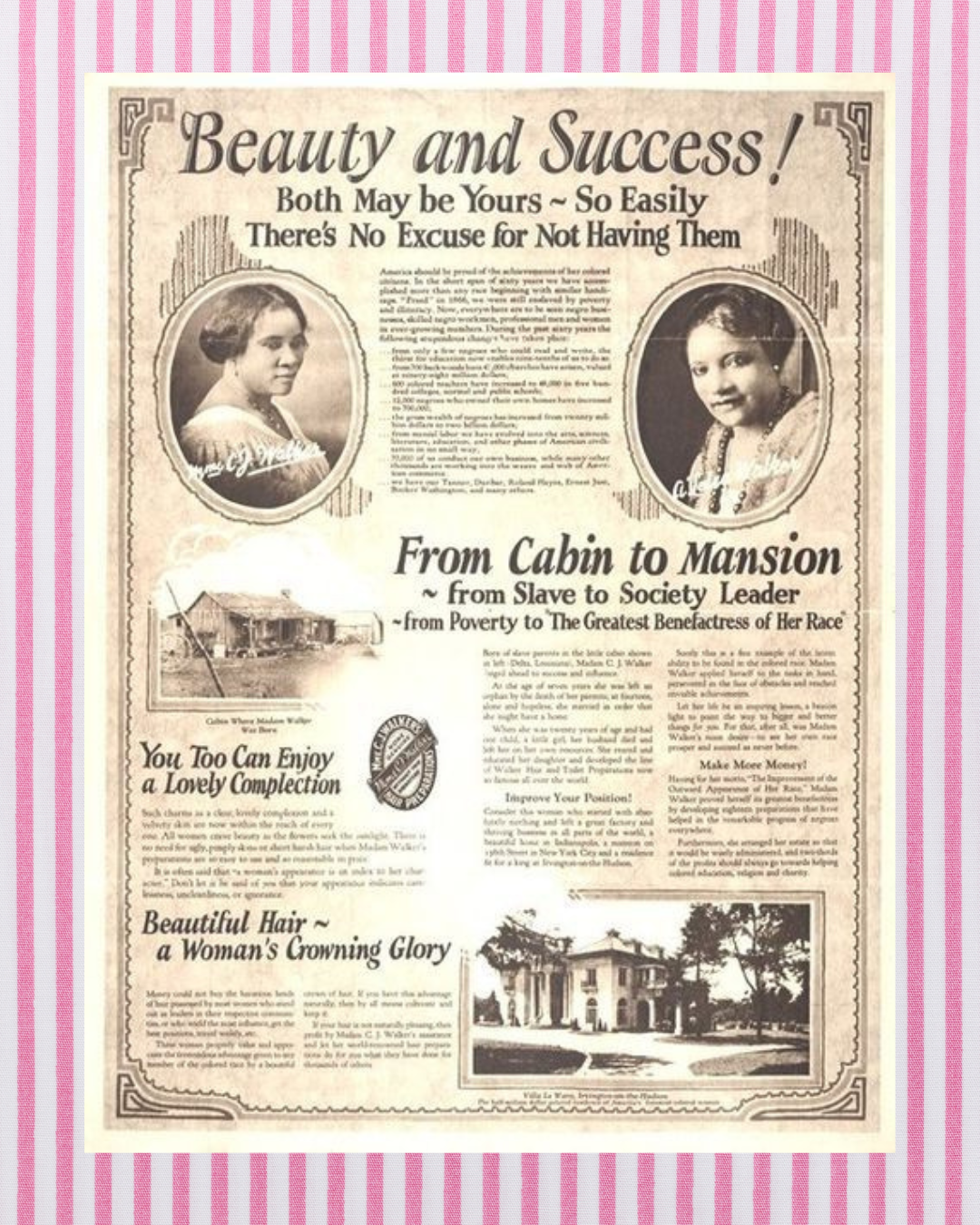
By 1908, Walker had opened her first beauty school — Lelia College of Beauty Culture in Pittsburgh, Pennsylvania — named after her daughter. Here, women learned not only how to use the products but also how to become professional “beauty culturists” who could teach others. This wasn’t just educational — it was economic empowerment. Sales agents earned commissions by selling products and services, giving them independence in a world where few Black women had access to stable income.
In 1910, Walker moved her operations to Indianapolis, Indiana, one of the nation’s largest manufacturing centers. There she built a factory, beauty salon, and training school. Indianapolis became the headquarters of what would soon be one of the most successful Black-owned businesses of the early twentieth century. By 1919, Walker’s company employed more than 25,000 active sales agents who worked across the United States and in the Caribbean, making the Madam C. J. Walker brand a cultural and economic force.
Walker regularly organized conventions and clubs for her agents, most notably the Madam C. J. Walker Hair Culturists Union of America, which some historians believe was among the first national businesswomen’s gatherings in the country. These gatherings were strategic, bringing training, recognition, and collective purpose to women previously pushed to society’s margins.
Madam C. J. Walker Philanthropy & Activism
Walker’s influence extended far beyond the beauty counter. With wealth and visibility came access, and she used both to advocate for her community. When a racist mob killed dozens of African Americans in East St. Louis in 1917, Walker joined other Black leaders in presenting anti-lynching petitions to the White House. She donated large sums to organizations like the NAACP, the Black YMCA, and institutions focused on education and women’s advancement.
Her estate — Villa Lewaro in Irvington-on-Hudson, New York — designed by architect Vertner Tandy, became a hub for prominent Black leaders, intellectuals, and artists during the Harlem Renaissance. The mansion symbolized not just personal success but national pride and cultural influence.
Madam C. J. Walker Legacy
Madam C. J. Walker died of complications from hypertension on May 25, 1919, at age 51, leaving behind a business worth well over $1 million — an astronomical figure for a Black woman in early twentieth-century America.
After her death, her daughter A’Lelia Walker took over the company, and the business continued to expand. In 1927, a new headquarters and manufacturing facility — today known as the Madam Walker Legacy Center — was built in Indianapolis and later designated a National Historic Landmark for its role in Black business and culture.
The original Madam C. J. Walker Manufacturing Company operated until 1981, when it ultimately closed its doors after decades of influence in the beauty world due to the Great Depression. However, in recent years the brand has experienced a revival, with new product lines released under the name Madam C. J. Walker Beauty Culture at major retailers.
If you would like to try Madam C.J. Walker’s products, there are only four products that are in circulation. The Amazon links that I have provided in my Benable list are the only sellers who sell her products. I can’t find an official website, and I don’t believe they are in any drugstores or retailers. These are the products that I did find. Shop here.
Many artifacts from Walker’s life — including product tins, promotional materials, and correspondence — are preserved in archives maintained by her family’s legacy foundation and museum exhibits at institutions like the Indiana Historical Society and the Madam Walker Legacy Center. These displays allow visitors to connect with the personal story and cultural impact of a woman whose reach remains historic.
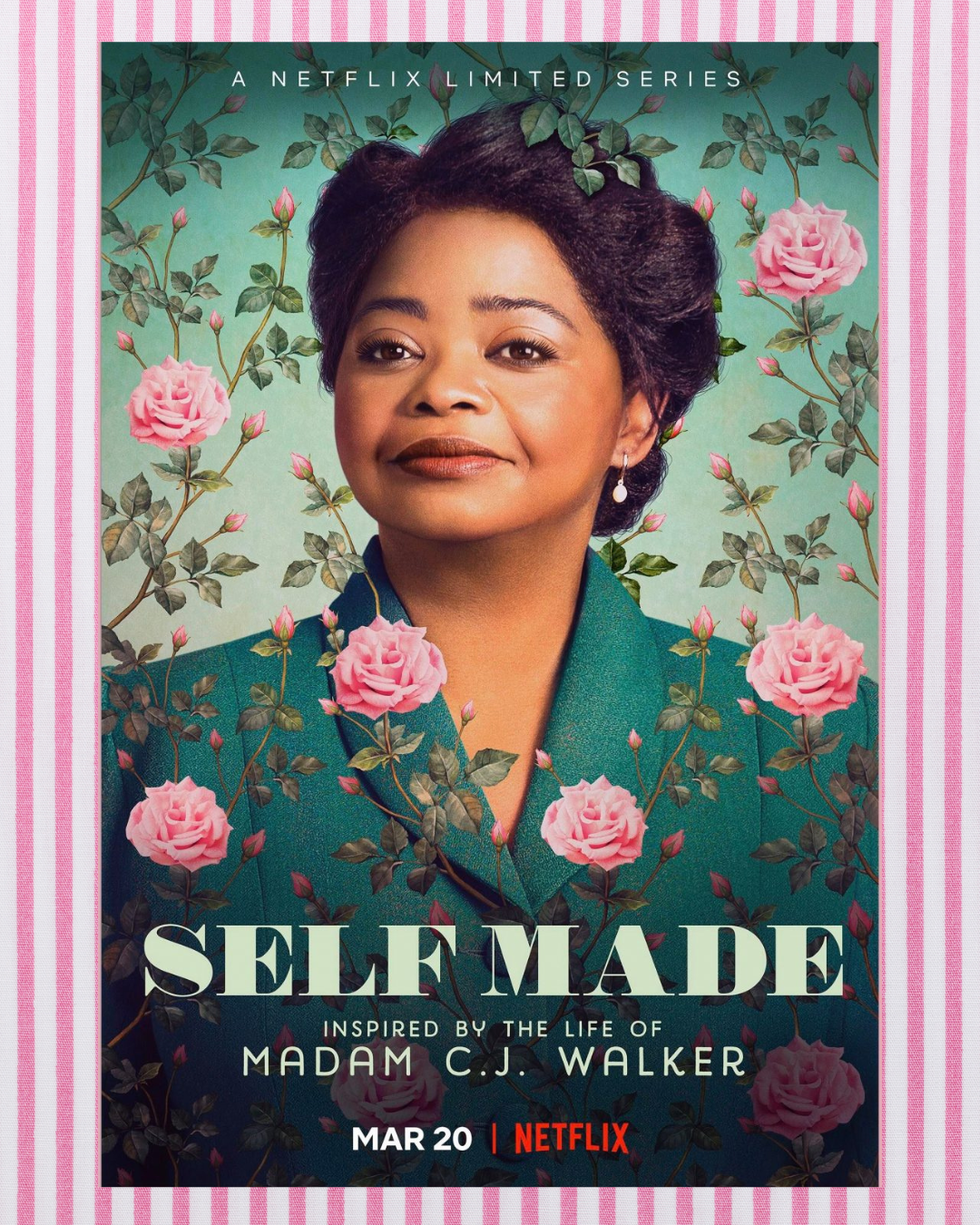
Netflix’s Self Made: Inspired by the Life of Madam C. J. Walker
The 2020 Netflix series Self Made: Inspired by the Life of Madam C. J. Walker brought this remarkable story to global audiences, starring Octavia Spencer as Walker. The show dramatizes pivotal moments in her life — from her early struggles to her rise as an entrepreneur.
However, it’s important for readers to understand that while Self Made captures the spirit of Walker’s determination and tenacity, it takes dramatic liberties with characters, timelines, and relationships for narrative effect. Some scenes and individuals are fictionalized or exaggerated, meaning the real story is richer and sometimes more complex than anything Hollywood can depict.
Still, the series does a great job of introducing Walker’s legacy to people who might never have encountered her in history books. It highlights her entrepreneurial strategy, the obstacles she faced as a Black woman in early twentieth-century America, and her unrelenting pursuit of economic justice through business. Overall, if you can still find it on Netflix, it’s definitely worth a watch.
Why Madam C. J. Walker Still Matters Today
What made Madam C. J. Walker extraordinary wasn’t simply that she made money — it was how she did it. She built community and taught other women how to support themselves. Her beauty products turned into an economic opportunity and used her business as a tool for activism and progress. Madam C. J. Walker sold confidence and possibility to women who had been systematically denied both.
Her legacy lives on in salons, in museums, in revived product lines, and in the very idea that people from any background can build something lasting. Walker’s life story continues to inspire entrepreneurs and beauty lovers alike, reminding us that innovation isn’t just about invention — it’s about meeting real needs with resourcefulness, courage, and heart.
If you would like to read more about vintage beauty products you can still buy today, check out “Maybelline Cosmetics Great Lash”.